
Self-Funded ETA, Without the Theory: Lessons from a Real Deal at Kellogg School of Management
1/28/20261 min read
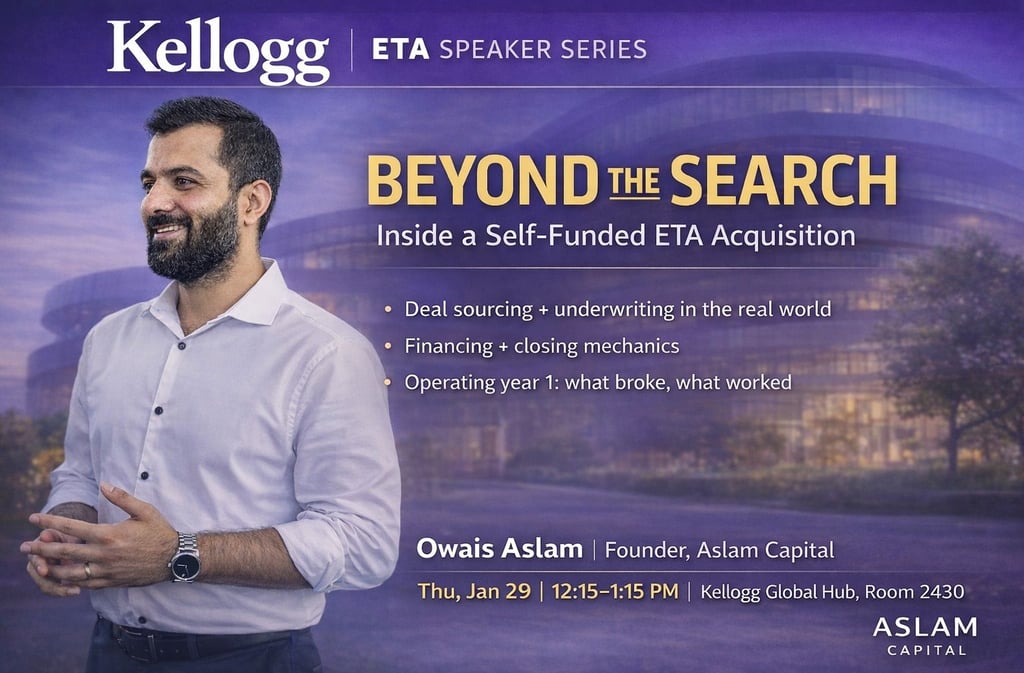
Owais Aslam spoke at Kellogg this week on self-funded entrepreneurship through acquisition—and kept the session deliberately practical. Rather than spending time on “search theory,” he walked the room through an actual deal from end to end: how it was sourced, why most opportunities they evaluated didn’t meet the bar, how the acquisition was financed without a fund, what broke in the first year, and what he would do differently next time.
The goal, in Owais’s view, is to close the gap between ETA as an idea and ETA as lived experience. Buying a business forces decisions under uncertainty—on quality of earnings, customer concentration, staffing, pricing power, and operational capacity. It’s easy to feel confident in a model; it’s harder when the day-to-day begins, and the assumptions start getting tested.
His central point was simple: the hard part of ETA often isn’t locating a business. It’s living with the consequences of your assumptions—especially when time, cash, and attention are limited. That’s why Owais advocates for deep diligence, conservative downside thinking, and an operator mindset that anticipates what will break first once ownership begins.
Owais invited anyone considering buying a business to reach out directly and shared an additional resource via his website.
Takeaways:
Real ETA learning happens in the post-close realities, not the spreadsheet.
Strong diligence is less about “finding upside” and more about surviving surprises.